
Held in Relationship: Why Group Retreats Sit at the Centre of our Work
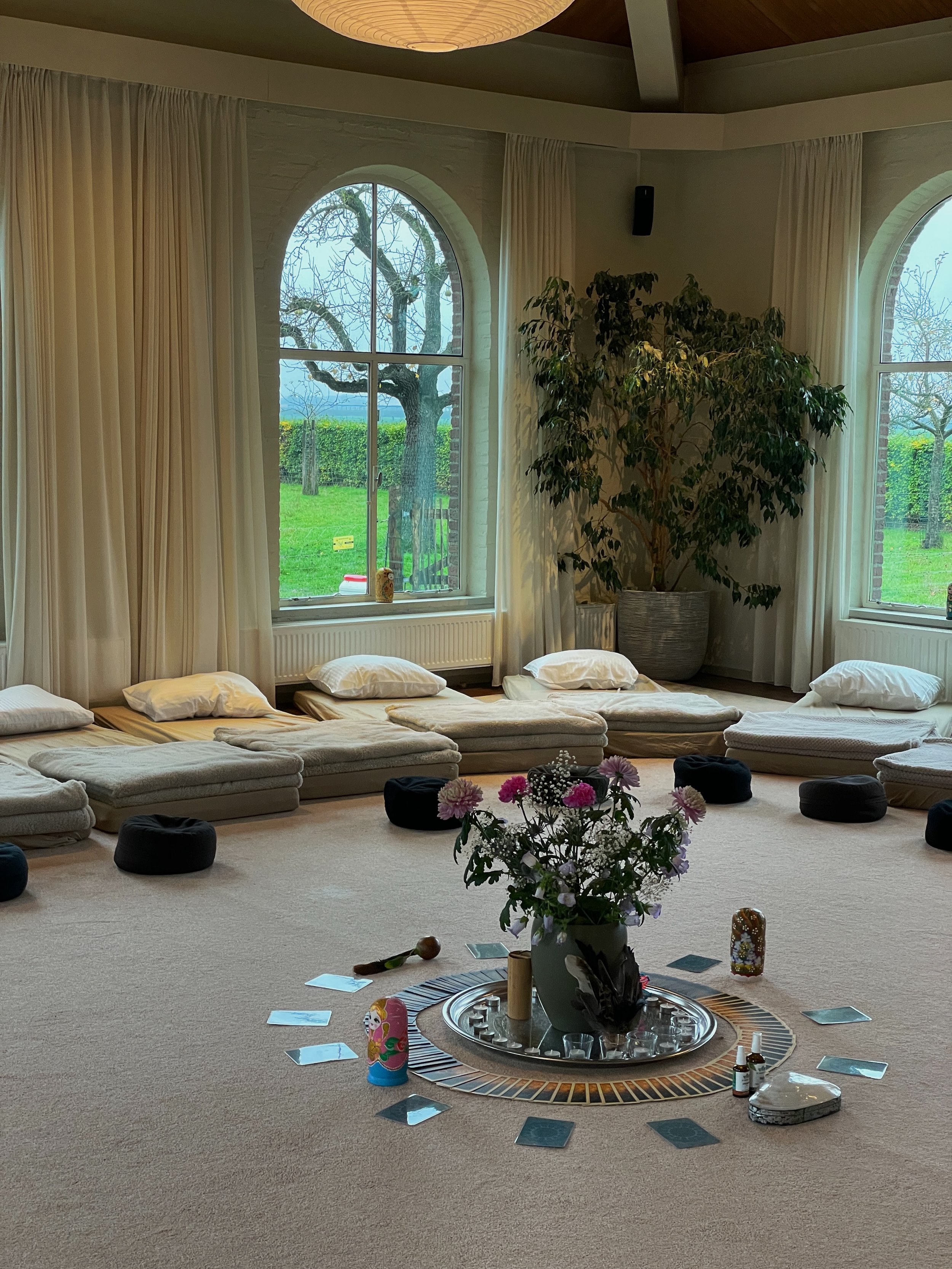
At the Experiential Training Institute, group retreats are not a secondary option or a stepping stone towards something “more individual”. They are the foundation of how we understand and hold psychedelic work.
While many people initially enquire about private journeys, our experience — across years of training, facilitation, and integration — has shown us that small, carefully held groups can offer the most supportive starting point for the majority of people. This isn’t about ideology or efficiency. It’s about how change actually unfolds when the work is given the right conditions.
Psychedelic work is personal — but rarely solitary
Psychedelic experiences can feel deeply internal: emotions, memories, sensations, insights arising from within. And yet, what is often touched beneath the surface is relational in nature — our sense of safety, belonging, trust, and connection.
For many people, the challenges they bring are not just cognitive or emotional, but shaped through relationship: how close they allow others to get, how they ask for support, how they make sense of themselves in the presence of others.
A small group retreat creates a relational field where this can be met gently and organically. Nothing is required to be shared. Nothing is forced. And yet, something shifts simply through being alongside others, moving through the work at a shared pace.
What we mean by “group retreat”
When we talk about group retreats, we are not referring to large ceremonies or anonymous group experiences.
Our retreats are intentionally small (max. 8 people), carefully facilitated (4 facilitators) and structured to prioritise safety, presence, and integration. Each participant remains sovereign in their experience, while being held within a wider container that includes experienced facilitators, clear agreements, and the steady rhythm of the group.
For many people, this offers something surprisingly supportive: a sense of being held without being singled out, accompanied without being analysed, and seen without needing to explain.
Why we begin with group work
It’s common to assume that one-to-one work is inherently safer or more appropriate — particularly if someone feels tender, uncertain, or new to psychedelic experiences.
In practice, we often find the opposite.
Group settings can be more regulating than exclusive one-to-one work because they:
reduce pressure to “go deep” or achieve a particular outcome
offer subtle co-regulation through shared presence and routine
normalise a wide range of experiences, emotions, and responses
support integration through listening and resonance, not interpretation
Rather than intensifying the spotlight, the group softens it.
This is why, by default, we guide people towards group retreats as a starting point — especially when they are new to this kind of work, feeling stuck or isolated, or navigating themes shaped in relationship.
Integration happens in relationship too
Insight alone is rarely the endpoint. What matters is how experiences are woven back into daily life — into relationships, choices, boundaries, and values.
Group retreats naturally support this process. Integration begins not only after the retreat, but during it: through shared meals, gentle conversation, silence, reflection, and witnessing others articulate what you may not yet have words for.
Often, people leave with fewer answers — but a stronger sense of orientation, grounding, and trust in their own unfolding process.
Where private journeys fit
Private journeys absolutely have a place within our work, and our team have extensive experience guiding and facilitating one-to-one programs.
We typically explore one-to-one work when there is a clear reason to do so: particular therapeutic needs, life circumstances requiring discretion, or when previous work has clarified a focused, individual next step.
Private journeys are not “deeper” or more advanced than group retreats. They are simply held differently, and they ask more of the individual in terms of internal resourcing and post-experience integration.
For this reason, they are offered as a responsive option rather than a default pathway.
Choosing the right container
The question we return to again and again is not what sounds most appealing, but what will best support the person in front of us — their nervous system, their history, and their life beyond the retreat itself.
Most often, that answer begins with a group.
Held in relationship, paced with care, and grounded in shared humanity, group retreats offer a way into the work that is both deeply personal and quietly collective.
If you’re unsure which container is right for you, we don’t expect you to decide alone. We invite conversation first — because discernment, too, is part of the work.