Psychedelic Facilitator vs Therapist: What’s the Difference?

As psychedelic practice develops, so does the language surrounding it.
You may encounter psychedelic facilitators, psychedelic practitioners, integration practitioners, psychedelic therapists, psychedelic-assisted therapists and healthcare professionals working with psychedelic experiences.
Sometimes these terms are used interchangeably.
But they do not necessarily describe the same role, training or professional responsibilities.
For someone considering working in this field, understanding those distinctions matters. Not only because they affect what training you might need, but because being clear about the limits of your role is an important part of practising safely and ethically.
In short: a psychedelic facilitator supports aspects of a psychedelic experience, but does not automatically hold a qualification to provide psychotherapy or clinical treatment. A therapist brings an existing therapeutic qualification and professional scope to the work. Psychedelic training can deepen either person's understanding of altered states, but it does not replace their underlying professional training.
What is a psychedelic facilitator?
A psychedelic facilitator is someone who supports another person around a psychedelic experience.
Depending on the setting, that might involve:
screening or intake
preparation
intention setting
creating and maintaining a supportive environment
being present during an altered state
responding to challenging experiences
supporting immediate integration
helping someone identify appropriate ongoing support
The facilitator's role is often less about doing something to the person having the experience and more about creating conditions in which that person can move through their own process with appropriate support.
That requires presence, judgement and relational awareness.
It also requires knowing where facilitation ends.
A facilitator may encounter grief, trauma, fear, relationship difficulties, psychological distress or deeply personal material during an experience. The fact that this material arises does not automatically make the facilitator qualified to treat it.
This is where professional scope becomes particularly important.
What is a psychedelic therapist?
A therapist is someone whose underlying professional training qualifies them to offer a recognised form of psychological therapy within the scope of their profession.
Depending on the country and profession, this might include psychotherapists, psychologists, counsellors or other appropriately trained mental health professionals.
A therapist working with psychedelic experiences therefore brings two layers of competence to the work.
The first is their existing therapeutic education, clinical or professional experience, ethical framework and scope of practice.
The second is specific education relating to psychedelics and altered states.
Psychedelic training does not create the first layer.
It builds upon it.
That distinction is particularly important when terms such as “psychedelic therapist” or “psychedelic-assisted therapy” are used, because they may imply the delivery of psychological treatment rather than facilitation alone.
So what is the main difference?
The simplest distinction is not necessarily what happens during a session.
It is the professional role in which someone is working.
A facilitator and therapist may both listen carefully, offer reassurance, support reflection and help someone navigate an emotionally intense experience.
But their professional responsibilities and what they are qualified to offer may be very different.
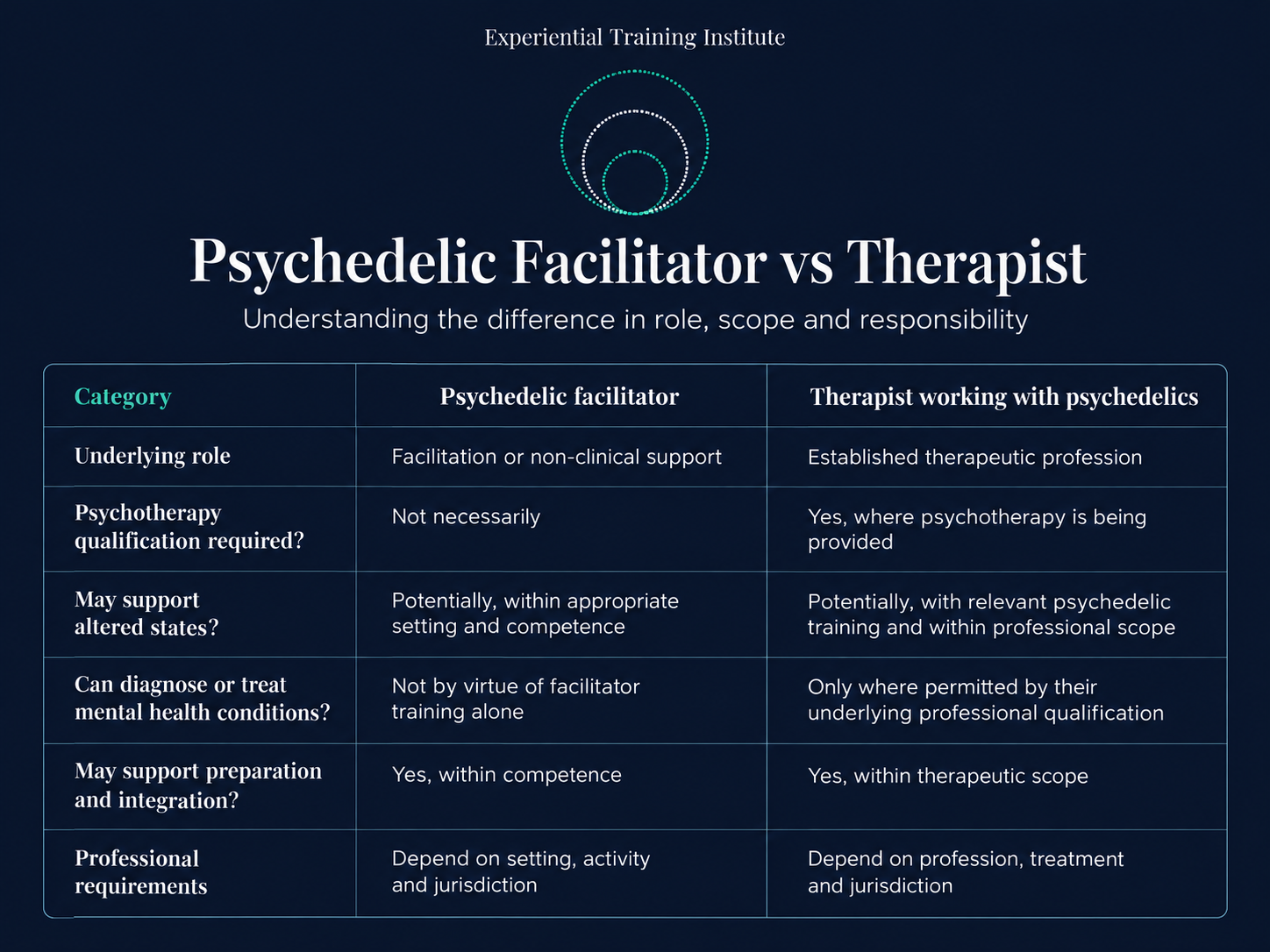
There will inevitably be overlap.
But overlap in skills does not mean equivalence in professional scope.
Where does a “psychedelic practitioner” fit?
“Psychedelic practitioner” is even broader.
It can be a useful umbrella term for people working around psychedelic experiences from a variety of backgrounds.
That might include:
psychologists and psychiatrists
psychotherapists and counsellors
doctors and nurses
coaches
wellbeing practitioners
facilitators
integration practitioners
researchers or educators
What the title does not tell you by itself is what that individual is qualified to do.
Two people may both describe themselves as psychedelic practitioners while having very different training, experience and professional responsibilities.
For that reason, the more useful questions are often:
What is your underlying professional background?
What psychedelic-specific training have you completed?
What exactly are you offering?
And where are the limits of your scope?
Do you need to be a therapist to become a psychedelic facilitator?
Not necessarily.
There are roles around psychedelic experiences that do not inherently require someone to practise psychotherapy.
Someone might support preparation, facilitation or integration within an appropriate non-clinical setting without presenting themselves as a therapist or offering psychological treatment.
But not needing to be a therapist does not mean that no training is required.
Supporting somebody in a non-ordinary state can involve considerable responsibility.
Practitioners need to understand screening, contraindications, vulnerability, consent, boundaries, challenging experiences, relational dynamics and when another professional needs to become involved.
Training should therefore help non-clinical practitioners become clearer about what they can offer and equally clear about what they cannot.
Can a therapist automatically facilitate psychedelic experiences?
The reverse is also important.
Being a qualified therapist does not automatically make someone competent to work with psychedelics.
Altered states introduce particular considerations that may not feature heavily within conventional therapeutic training.
These can include:
changes in perception and sense of self
heightened suggestibility and vulnerability
unusual relational dynamics
intense somatic or emotional experiences
difficult or disorientating experiences
psychedelic-specific screening considerations
preparation for altered states
immediate and prolonged integration
the influence of music, setting and ritual
different considerations around touch and consent
An experienced therapist may therefore have strong relational and psychological foundations while still requiring specific education and experience before working responsibly around psychedelics.
Neither professional training nor psychedelic training replaces the other.
Why boundaries become particularly important
The distinction between facilitation and therapy becomes especially important when difficult psychological material arises.
Imagine somebody begins speaking about childhood trauma during a psychedelic experience.
A facilitator might listen, help them stay grounded, support their sense of safety and allow the experience to unfold without trying to interpret or treat what is emerging.
A therapist with appropriate training may have additional competencies for working therapeutically with trauma.
But even then, the altered state introduces questions about timing, consent and suggestibility.
The fact that an intervention could be made does not necessarily mean it should be.
Good psychedelic practice therefore requires more than techniques.
It requires judgement about when to intervene, when to remain present, when to explore something later, and when another form of support may be more appropriate.
Preparation and integration can also look different
Preparation and integration are sometimes spoken about as if they are single practices.
They are not.
For one person, integration may involve rest, journalling, reconnecting with their body or making gradual changes in everyday life.
For another, an experience may surface material that is better explored through ongoing psychotherapy.
Someone experiencing sustained distress may require psychological or psychiatric assessment rather than further integration coaching.
The appropriate form of support depends upon what is happening for the person and the competencies of the person supporting them.
Good practitioners should therefore be able to recognise the difference between:
something they can hold themselves
and
something that needs to be referred onwards.
What training should a psychedelic facilitator have?
There is currently no single European qualification that defines a psychedelic facilitator.
Training programmes differ considerably.
However, anyone preparing to support others around psychedelic experiences should develop understanding across the wider arc of the work, including:
screening and intake
preparation
psychedelic substances and altered states
ethics
consent
professional boundaries
relational dynamics
challenging experiences
facilitation
immediate and prolonged integration
referral and professional scope
reflective practice and intervision
Training should also create opportunities to practise judgement rather than simply accumulate information.
Role play, case discussion, scenario planning, experiential learning and feedback can all help bridge the gap between knowing a principle and being able to respond to another person in real time.
Does experiential learning matter?
At ETI, we believe it does.
There are dimensions of psychedelic facilitation that are difficult to understand through theoretical education alone.
Being vulnerable, relinquishing some control, trusting another person, experiencing uncertainty and returning from an altered state can all provide another perspective on what may be asked of someone entering a psychedelic experience.
But this needs an important qualification.
Having psychedelic experiences does not make somebody a competent facilitator.
Personal experience is not professional training.
We see experiential learning instead as one part of a wider process that also includes education, practical skills, ethics, reflection, feedback and continued development.
Within ETI's Core Practitioner Training, participants therefore encounter both sides of the relationship, experiencing the participant role as well as practising the facilitator role within a carefully held training environment.
Why this distinction may become even more important
Psychedelic care is evolving.
Today, psychedelic work exists across research, healthcare, retreat, ceremonial, wellbeing and community settings.
Future regulated treatments are also likely to introduce increasingly specific requirements about who can deliver particular interventions and what professional training those individuals need.
That means the field may become more differentiated, rather than less.
There may be roles for facilitators who are not therapists.
There may be roles that explicitly require psychologists, psychiatrists or other healthcare professionals.
And there may be multidisciplinary models in which different people hold different responsibilities across screening, prescribing, preparation, psychedelic sessions and integration.
Rather than trying to collapse all of these into a single new profession, it may be more useful to become clearer about the competencies each role requires.
Which pathway is right for you?
If you are considering training, start with the role you hope to play rather than the title you would like to use.
If you are already a therapist or healthcare professional, psychedelic practitioner training may help you understand how your existing skills translate into work involving altered states, and where additional competencies are required.
If you come from coaching, facilitation or wellbeing, training can help you develop the knowledge and practical skills relevant to non-clinical psychedelic support while becoming clearer about the boundaries of that work.
If you hope ultimately to provide psychotherapy or clinical psychedelic treatment, psychedelic training alone is unlikely to be sufficient. Your wider professional pathway matters too.
There is no need for everyone entering this field to become the same kind of practitioner.
What matters is being clear about who you are, what you know, what you are trained to provide and when somebody needs something beyond you.
ETI's approach to Psychedelic Practitioner Training
The Experiential Training Institute brings together people from a range of professional backgrounds.
Our participants include psychologists, psychiatrists, counsellors, doctors, nurses and other healthcare professionals alongside coaches, wellbeing practitioners, students, trainees and people moving towards work within the psychedelic field.
Our 2027 Core Practitioner Training combines 20 live online Education sessions across two semesters with a four-day Experiential Retreat in the Netherlands.
Across the programme, participants explore the full arc of psychedelic facilitation: screening, preparation, ethics, consent, boundaries, facilitation, challenging experiences, immediate and prolonged integration, case discussion and continued development.
The Experiential Retreat creates an opportunity to move between participant and facilitator perspectives, bringing the relational and practical dimensions of the work alongside its theoretical foundations.
Importantly, the programme is not a licence to practise psychedelic-assisted therapy and does not replace the qualifications, registrations or authorisations required to provide clinical or therapeutic services within a particular country or profession.
Instead, the intention is to develop greater knowledge, practical skill, embodied understanding and clarity about what responsible psychedelic practice asks of us.